
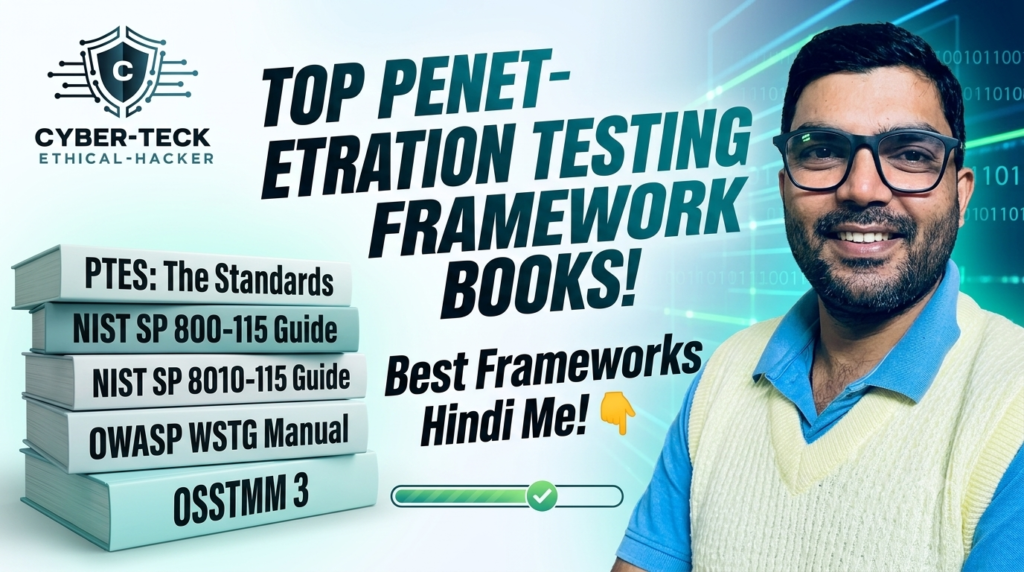
Cybersecurity mein penetration testing sirf vulnerabilities dhoondhne ka naam nahi hai. Ek professional penetration test ke liye ek structured methodology follow karna bahut important hota hai. Isi kaam ke liye penetration testing frameworks use kiye jaate hain.
Simple words mein, penetration testing framework ek roadmap ki tarah hota hai jo security professionals ko batata hai ki assessment ko planning se lekar testing, exploitation, reporting aur remediation validation tak systematically kaise perform karna hai.
Penetration testing framework ek predefined methodology hai jo testing ke different phases ko organize karti hai. Iska main purpose ye ensure karna hai ki tester:
- Important areas ko systematically test kare
- Testing ke dauran consistent methodology follow kare
- Findings ko properly document kare
- Client ko clear report provide kare
- Security improvements ko validate kare
Note: Agar tester bina methodology ke testing kare, to important vulnerabilities miss hone ka risk badh sakta hai.
Framework follow karne ke kai key benefits hain:
- Thorough Testing: Systematic approach provide karta hai jisse important systems accidentally skip nahi hote.
- Consistency: Team ke multiple testers same framework follow karte hain, jisse reporting aur results consistent rehte hain.
- Compliance: Regulatory requirements aur industry standards se security assessment ko align karne mein help milti hai.
- Better Reporting: Findings ko structured aur professional way mein document karna aasan hota hai.
- Client Communication: Client ko clear samajh aata hai ki testing kitni systematic methodology ke sath ki gayi hai.
1. OSSTMM (Open Source Security Testing Methodology Manual)
Ye security testing ke liye ek scientific aur metrics-driven approach provide karta hai. Iska focus sirf vulnerability scanning par nahi, balki security ko measurable aur repeatable manner mein assess karne par hota hai.
Useful for: Structured security testing, security controls measurement, aur technical assessments.
2. OWASP Web Security Testing Guide (WSTG)
Web application security testing ke liye WSTG sabse important resource hai. Ismein authentication, authorization, session management, aur input validation jaise areas cover hote hain.
3. NIST SP 800-115
Technical Guide to Information Security Testing and Assessment: NIST ka ye document formal aur documented process ke according information security testing plan, conduct aur analyze karne mein guidance deta hai.
4. PTES (Penetration Testing Execution Standard)
PTES real-world engagements ke workflow ke kaafi close hai. Ye testing ko 7 key phases mein divide karta hai:
- Pre-engagement Interactions
- Intelligence Gathering
- Threat Modeling
- Vulnerability Analysis
- Exploitation
- Post-Exploitation
- Reporting
5. ISSAF (Information Systems Security Assessment Framework)
Ye ek detailed security assessment methodology hai jo historically penetration testing ke context mein widely reference ki jaati hai.
6. MITRE ATT&CK
Ye traditional framework se alag ek knowledge base hai jo real-world adversary behavior ko tactics aur techniques mein organize karta hai (e.g., Reconnaissance, Initial Access, Lateral Movement, Exfiltration, etc.).
- WASC Threat Classification: Web application threats ko categorize karne ke liye.
- CSA Cloud Controls Matrix (CCM): Cloud security controls ko assess karne ke liye.
- OWASP MASTG: Mobile Application Security Testing Guide (Android & iOS ke liye).
- PCI DSS Guidance: Payment card environment ke penetration testing requirements ke liye.
- CBEST Framework: Financial sector ke liye threat intelligence-led security assessment.
Kaunsa Framework Kab Use Karein?
| Framework | Primary Focus |
|---|---|
| OSSTMM | Scientific & metrics-driven security testing |
| OWASP WSTG | Web application security testing |
| NIST SP 800-115 | Security testing & assessment guidance |
| PTES | Practical penetration testing lifecycle |
| ISSAF | Detailed security assessment methodology |
| MITRE ATT&CK | Adversary tactics & techniques |
| WASC | Web application threat classification |
| CSA CCM | Cloud security controls |
| OWASP MASTG | Mobile application security |
| PCI DSS | Payment card security requirements |
| CBEST | Threat-led financial sector assessments |
Conclusion: Goal kisi framework ko blindly follow karna nahi, balki security assessment ko thorough, consistent aur repeatable banana hai. In methodologies ko samajhne se aapko practical workflow sikhne mein help milegi.